
A marathon does not end at the finish line. For organisers, one of the most important responsibilities begins after the race: verifying the winners.
Marathons attract participants from different age groups, genders, cities and backgrounds. Many events offer prizes across multiple categories, such as 18–30 years, 31–40 years, 41–50 years and 51+ years.
But how can an organiser be certain that the person claiming a prize actually meets the eligibility criteria? Is the participant’s date of birth correct? Does the submitted identity document belong to the registered runner? Did the same person who registered actually complete the race? Was the correct BIB used?
To address these challenges, Team Sportifi has developed an integrated Digital Winner Verification System, connecting runner registration, race results, event photographs and AI-powered identity verification in one workflow.
The system is designed to help organisers verify provisional winners through OTP authentication, DigiLocker integration, PAN verification, BIB matching, liveness checks, AI-powered face matching and race evidence.
The objective is to make winner verification more reliable, transparent, organised and scalable for running events.
1. Why Is Winner Verification Important in a Marathon?
Many marathon organisers announce provisional results based on timing records immediately after the event. However, timing alone cannot establish whether a runner is eligible for a particular age or gender category.
Common issues include:
- Participants claiming prizes in incorrect age categories.
- Incorrect or altered age-proof documents.
- Someone else running using the registered participant’s BIB.
- Male participants using female-category BIBs or vice versa.
- Identity mismatches between registration documents and race photographs.
- Duplicate registrations or suspicious prize claims.
- Discrepancies between BIB numbers, timing records and race photographs.
If these issues are not identified before final results are declared, the event may face complaints, disputes and loss of trust among genuine participants.
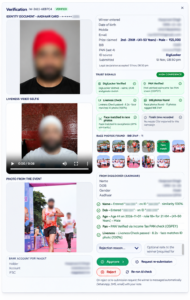
The screenshot of the submitted verification by Winner
A transparent verification process protects both organisers and runners.
2. The Biggest Challenges Faced by Marathon Organisers
Traditionally, winner verification involves collecting documents through email or WhatsApp, manually checking identity proofs, contacting participants and comparing race photographs.
This process becomes difficult when an event has hundreds or thousands of participants.
Organisers need a system that connects participant identity, eligibility, race participation, photographs and official timing records.
3. Sportifi’s Integrated Digital Winner Verification System
Sportifi brings together three important parts of marathon management:
- Sportifi Photo Publishing System – Publishing and organising race photographs captured at different points on the course.
- Race Results and Timing Integration – Connecting BIB numbers, participant records and race results.
- AI-Powered Digital Winner Verification – Verifying provisional winners through identity documents, age checks, liveness and race-photo matching.
These systems work together so that information collected during registration, race-day photography, results processing and post-event verification can support a connected workflow.
Instead of treating photographs, timing results and winner documents as separate records, Sportifi connects available information to help organisers verify participants more efficiently.
4. How Does the Integrated System Work?
Step 1: Create a Digital Winner Verification Campaign
The organiser creates a verification campaign through the Sportifi organiser dashboard.
The campaign can include:
- Event name and details.
- Provisional winner categories.
- Age and gender eligibility criteria.
- Prize positions and amounts.
- Verification deadline.
- Required documents and declarations.
Once configured, the organiser generates a public verification link and QR code.
Step 2: Share the Verification Link with Winners
The organiser shares the verification link with provisional winners through WhatsApp, SMS, email or other communication channels.
Participants open the link and complete the verification process digitally.
Step 3: OTP-Based Mobile Authentication
The participant verifies their mobile number through a One-Time Password (OTP).
This helps establish control over the submitted mobile number and creates an authenticated starting point for the verification process.
Step 4: Verify Age Through DigiLocker
Age verification is one of the most important parts of marathon winner verification.
Sportifi integrates DigiLocker to help participants provide eligible government-issued documents digitally.
Subject to participant consent, document type and available issuer verification services, relevant details can be checked, including:
- Participant’s name.
- Date of birth.
- Gender, where available.
- Document verification status.
The participant’s date of birth is compared with the event date and the age-category eligibility rules.
For example, if a participant claims a prize in the 41–50 years category, the system can calculate their age on the event date and identify whether they fall within the permitted range.
This reduces dependence on manually uploaded screenshots and helps organisers authenticate supported government-issued documents.
Step 5: PAN Card and Other Identity Verification
Sportifi can also use supported PAN verification and other identity-document checks to strengthen the process.
These checks may include:
- Name matching.
- PAN verification through supported services.
- Identity-document comparison.
- Detection of mismatched or duplicate information.
- Review of inconsistent participant details.
PAN is an identity and tax-related document; it should not be treated as independent proof of date of birth.
Step 6: BIB Number and Registration Matching
Every runner is associated with a registration record and BIB number.
The system compares submitted information with the original event registration data, including:
- Registered participant name.
- Mobile number.
- Registration reference.
- BIB number.
- Claimed prize category.
- Gender and age-category information.
If the submitted details do not match the original registration, the submission can be flagged for further review.
Step 7: Liveness Check Through Selfie or Video
A document photograph alone cannot establish that the person submitting verification is the actual participant.
Sportifi can use a selfie or liveness video check to strengthen identity verification.
The submitted live image can be compared with the identity-document photograph, where supported.
This helps identify potential impersonation and cases where someone else may be attempting to claim a prize.
Step 8: Automated AI Race Photograph Matching
This is one of the most valuable advantages of connecting Sportifi Photo Publishing with its Digital Winner Verification System.
In a marathon, photographs are captured at multiple locations along the route. These may include:
- Starting point.
- Midpoint or route checkpoints.
- U-turn point.
- Other designated course locations.
- Finish line.
When these photographs are uploaded and organised through Sportifi’s Photo Publishing System, they can be connected with BIB numbers and participant verification records.
When a provisional winner submits their documents and completes verification, the system can use available race photographs to help identify relevant images and perform AI-powered face matching.
The organiser can then see the available race photographs associated with the participant’s BIB and review the face-match results directly through the verification dashboard.
This helps organisers investigate important questions:
- Is the person in the race photographs the same person who registered?
- Does the participant’s face match the submitted identity photographs?
- Are there photographs of the same BIB at multiple race points?
- Is the person appearing at the finish line consistent with the registered participant?
- Are there any possible BIB-sharing or identity-mismatch concerns?
Rather than manually searching thousands of event photographs, organisers can use automated photo discovery and matching to make the verification process more efficient.
AI face matching provides supporting evidence and similarity indicators, not conclusive proof on its own. Organisers should review flagged cases and consider image quality, lighting, camera angles and other available evidence.
Step 9: Race Results and Timing Verification
Sportifi’s race results can also be connected with the winner verification workflow.
When organisers upload available runner results, the system can use the BIB number and registration information to connect the timing record with the participant’s verification submission.
Relevant checks may include:
- BIB number matching.
- Official timing records.
- Finish time.
- Recorded distance.
- Category and position.
- Timing data imported from the event result system.
This creates a connected verification process in which participant identity, race photographs and timing information can be reviewed together.
If results have not been uploaded or a discrepancy is found, the system can indicate that further action is required.
5. A Real Example: Detecting BIB Misuse at a Recent Uttar Pradesh Event
The importance of digital winner verification became particularly clear during a recent event organised in Uttar Pradesh.
During the verification process, the system helped identify cases where male runners appeared to have participated using BIBs assigned to female participants.
These cases could have been difficult to identify through timing records alone.
By connecting participant details, BIB information and available race photographs with the digital verification workflow, the organiser could identify potential gender-category mismatches and investigate them before finalising the results.
This demonstrates why marathon winner verification must go beyond checking finish times.
A runner may have a valid timing record, but that does not automatically establish that the correct registered participant completed the race or that the participant is eligible for the claimed category.
The system helps organisers identify such discrepancies and review them with supporting evidence before making a final decision.
The objective is simple: ensure that the person who registered, the person who ran and the person claiming the prize are properly verified.
6. Duplicate and Suspicious Submission Detection
Sportifi can also help organisers identify potential issues such as:
- Duplicate verification submissions.
- Repeated identity documents.
- Inconsistent participant information.
- Multiple claims associated with conflicting details.
- Suspicious or potentially altered documents.
- Conflicting BIB and identity records.
These cases can be flagged for manual investigation rather than automatically treated as fraud.
7. One Dashboard for Complete Winner Verification
Collecting information is only one part of the process. Organisers also need a central place to monitor every submission.
Sportifi provides an organiser dashboard where verification information, trust signals and available supporting evidence can be reviewed.
Submissions can be organised into statuses such as:
- Received: Verification information submitted.
- Verified: Required checks completed successfully.
- Mismatch: One or more details do not match.
- Review: Manual investigation required.
- Rejected: Submission rejected by the authorised organiser.
- Re-submission Requested: Participant needs to provide additional or corrected information.
- Paid: Prize payout recorded.
The organiser can review participant details, document checks, BIB information, race photographs, face-match indicators and timing information from the available records.
This reduces the need to manage separate spreadsheets, emails and WhatsApp conversations.
8. Multiple Trust Signals for Stronger Verification
| Verification layer | What it helps establish |
|---|---|
| OTP authentication | Control of the submitted mobile number |
| DigiLocker | Supported government-issued document details |
| PAN verification | Identity-related cross-check |
| Registration matching | Consistency with original registration |
| BIB verification | Correct participant and race entry |
| Liveness check | Presence of the person submitting verification |
| AI face matching | Similarity between identity and race photographs |
| Photo publishing integration | Race photographs from available course locations |
| Timing verification | Consistency with official result records |
| Duplicate detection | Repeated or conflicting submissions |
| Manual review | Final assessment of flagged cases |
The strength of the system comes from combining multiple checks instead of depending on just one document or technology.
9. How Does This Protect Genuine Runners?
Every genuine runner invests time, effort and dedication in preparing for a marathon.
A structured verification process helps ensure that:
- Prizes are awarded to eligible participants.
- Age-category claims are checked against date of birth.
- Gender-category eligibility is reviewed.
- Identity and registration information are cross-checked.
- Potential BIB misuse is investigated.
- Timing and race photographs are considered.
- Participants receive an opportunity to correct discrepancies.
- Final results are based on documented checks and organiser approval.
The objective is to protect the integrity of the competition and ensure fair recognition for genuine participants.
10. Can Any System Guarantee 100% Accuracy?
No single technology or automated check can guarantee that every possible error or fraudulent attempt will be detected.
However, a multi-layer verification process can significantly strengthen accuracy and reduce the risk of incorrect prize claims.
For reliable results, organisers should combine government-source document verification, registration and BIB matching, identity and liveness checks, race photographs, official timing data, duplicate detection and human review.
The goal should be maximum verification accuracy supported by evidence and transparent decision-making, rather than an unsupported guarantee of 100% accuracy.
11. Data Privacy and Responsible Verification
Winner verification involves personal information such as identity documents, photographs, dates of birth and contact details.
Organisers and technology providers should follow applicable data protection requirements and use personal information only for legitimate verification purposes.
A responsible process should include participant consent, transparent collection purposes, secure access, appropriate retention policies, restricted access for authorised personnel and a process for participants to raise disputes or request corrections.
A trustworthy verification system must protect both event integrity and participant privacy.
12. The Future of Marathon Winner Verification Is Digital
As running events grow across India, the responsibilities of organisers are also increasing.
Participants expect transparent results, fair prize distribution and professional event management. Organisers need reliable technology that reduces manual effort and helps them manage complex verification requirements.
Sportifi connects three important parts of event management:
Photo Publishing + Race Results + AI Digital Winner Verification.
When these systems work together, orgGenerate
Suggested additional headline for the blog or social media promotion:
“One BIB. One Runner. One Verified Winner. How Sportifi Connects Race Photos, Results and AI to Protect Fair Play.”
This makes the key differentiator clear: Sportifi is not just a document verification tool; it connects race-day evidence with post-event winner verification.
For complete sports event solutions signup today at Sportifi for query you may email at contact@sportifiindia.com to call at 9871497413 this ticketing platform is Indi’s most advanced AI Powered Platform
These services are open for all organisers anyone can use this services provided by Sportifi.

