

Why Marathon Routes Are Measured—and Why It Matters More Than You Think
On a cool race morning, as thousands of runners gather at the start line, there’s an unspoken agreement everyone shares: the distance ahead is real. Whether you’re chasing a personal best, qualifying for a dream race, or simply hoping to finish, you trust that the course is exactly what it claims to be—42.195 km for a marathon, 21.097 km for a half.
But that trust isn’t automatic. It’s built—carefully, methodically, and scientifically—through a process called course measurement.
And once you understand what goes into it, you’ll never look at a race the same way again.
The Invisible Backbone of Every Race
Course measurement is not just about figuring out how long a route is. It’s about ensuring that the distance is never shorter than advertised, and that every runner competes on a fair and globally comparable course.
Unlike a track, where distances are fixed and controlled, road races twist through cities, highways, and landscapes. There are turns, elevations, traffic restrictions, and unpredictable surfaces. Measuring such a route isn’t simple—it’s precise work guided by international standards set by World Athletics and AIMS.
At the heart of it lies a simple but powerful concept:
The course must be measured along the shortest possible route a runner could take.
Imagine stretching a string tightly along the road, cutting every corner perfectly—that’s the line that gets measured. Not what runners usually do, but what they could do.
When a Few Meters Change Everything
It might sound dramatic, but in distance running, even a small error can have big consequences.
A marathon isn’t “about 42 km.” It’s exactly 42.195 km. And the allowed margin of error is just 0.1%—about 42 meters .
That’s less than half a football field.
Now imagine this:
- A runner misses a qualification time by seconds because the course was slightly long
- Or worse, achieves a personal best on a course that turns out to be short—and the time is invalid
For elite athletes, it can mean lost records.
For amateur runners, it can mean lost dreams.
Accuracy isn’t a luxury—it’s everything.
How Do You Measure 42.195 Kilometers on Open Roads?
Here’s where things get fascinating.
Despite all modern technology, the most accurate way to measure a road race is still surprisingly old-school: a calibrated bicycle fitted with a Jones Counter.
This device doesn’t measure distance directly. Instead, it counts the revolutions of the bicycle wheel, with each count representing roughly 9 centimeters on the ground .
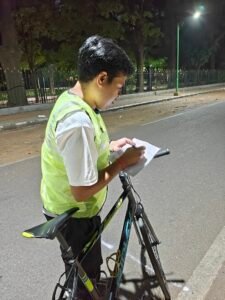
Parth Kushwaha (Picture while practicing Route measuring)
The Process, Simplified
Before measuring the actual race route, measurers first create a calibration course—a carefully measured stretch of road, usually 300–500 meters long. They ride over it multiple times to determine exactly how many wheel counts equal a known distance.
Then comes the real work:
- The measurer rides the entire race route
- Follows the shortest possible path throughout
- Records counts for every segment
- Re-calibrates again after finishing
Finally, all the data is analyzed to determine the exact course length.
It’s not just a ride—it’s a controlled experiment.
The Safety Net: Making Sure the Course Is Never Short
One of the most important safeguards in course measurement is something called the Short Course Prevention Factor (SCPF).
In simple terms:
A small buffer of 0.1% is added to the measurement
This ensures that even if minor variations occur—due to temperature, tyre pressure, or road conditions—the course will never be shorter than it should be.
Because in running, a course that’s too long is frustrating—but a course that’s too short is unacceptable.
The Science Behind the Precision
What makes course measurement so challenging is that it’s affected by real-world variables most runners never think about.
Temperature Matters
Steel measuring tapes expand in heat and contract in cold. Bicycle tyres behave differently depending on temperature too. Even a few degrees can affect accuracy.
Tyre Pressure Matters
A slightly under-inflated tyre changes the wheel circumference—and therefore the measurement.
Road Surface Matters
Smooth asphalt and rough roads affect how the tyre rolls, which can change calibration.
That’s why measurers calibrate their equipment before and after measuring—and sometimes even during.
It’s precision under constantly changing conditions.
Why Measurement Matters Beyond Distance
Records and Recognition
If a course isn’t measured according to international standards, performances don’t count.
World records, national records, and even age-group achievements require certified courses.
Qualification for Major Races
Events like the Boston Marathon only accept qualifying times from certified races.
So even if you run the time of your life—if the course isn’t measured properly, it doesn’t count.
Fair Competition
Every runner deserves the same challenge.
A short course gives unfair advantage.
A long course punishes effort.
Measurement ensures fairness for all.
Credibility for Organizers
For race directors, certification is a badge of professionalism.
It builds trust, attracts elite athletes, and opens doors to global recognition.
Without it, a race is just another run—not a competitive event.
When Things Go Wrong
There have been races around the world where courses were later found to be inaccurate.
The results?
- Records disqualified
- Runners frustrated
- Events losing credibility
In some cases, participation dropped the following year.
Because once trust is broken, it’s hard to rebuild.
More Than Distance: Planning and Safety
Accurate measurement doesn’t just define the race—it shapes the entire event.
It helps organizers:
- Place hydration stations correctly
- Plan medical support effectively
- Manage traffic and road closures
- Ensure runner safety across the course
A well-measured course is also a well-organized race.
The People Behind the Precision
Behind every certified race is a trained course measurer—someone who understands both the science and the responsibility of getting it right.
They don’t just measure distance.
They document every detail—maps, landmarks, routes—so precisely that anyone can recreate the course exactly.
It’s a role that demands patience, expertise, and accountability.
India’s Running Boom—and the Road Ahead
India is in the middle of a running revolution.
From major city marathons to grassroots events, participation is growing rapidly. But with that growth comes responsibility.
To truly elevate Indian races to global standards, accurate course measurement must become the norm, not the exception.
With limited certified measurers currently available, investing in training and awareness is critical.
Because if India wants to be a global destination for runners, its races must meet global benchmarks.
AIMS Course Measurement Workshop, Bangaluru:-
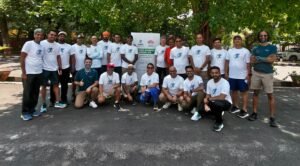
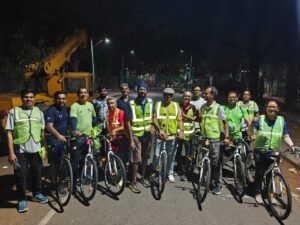
The Association of International Marathons and Distance Races, in collaboration with World Athletics, conducted a specialized Course Measurement Workshop in Bengaluru from 20–24 April 2026. The workshop brought together leading race organizers from across India, including Parth Kushwaha (Thrill Zone), along with organizers of the Vedanta Pink City Jaipur Half Marathon, AU Jaipur Marathon, NEB Sports, Bodhgaya Marathon, and Ladakh Marathon, Bangaluru Night Marathon, JBG Kolkata Marathon, Goa Marathon, Pune Marathon, Hydeerabad Marathon, Adani Marathon Ahmedabad among other major race directors. Participants underwent hands-on training in globally recognized course measurement standards, combining theory with practical field techniques. This initiative is expected to significantly enhance the accuracy, credibility, and global recognition of road races across India.
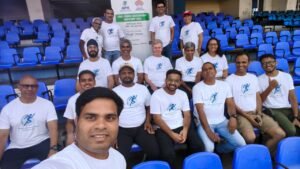
The workshop was conducted by Hugh Jones, winner of 1982 London Marathon, Secretary of AIMS, course measurer for London Olympics and many other world renowned races including Tata Mumbai Marathon. “Accurate course measurement is fundamental to the integrity of our sport. As road running continues to expand globally, it is essential that races in India adhere to consistent international standards and make it a destination for road races for international participants,” says the legend.
Rajesh Vetcha, AIMS-India board member, took the initiative to organise this workshop and is of the opinion that, “India with nearly 1100 timed races and with road running being the fastest growing sport, course measurement is one of the integral aspect of the race and is the foundation of credibility in distance running.”
This course measurement workshop was organized after a gap of eight years, marking a significant step in strengthening technical expertise and standards in Indian road racing.
Did You Know?
- The allowed error in measurement is just 0.1%
- A course certificate is valid for 5 years
- The bicycle method is still the only officially accepted system worldwide
- Measuring follows the shortest possible route—not the path runners usually take
Final Thoughts: Measuring More Than Distance
At its core, course measurement is about one thing: trust.
Trust that your effort counts.
Trust that your time is valid.
Trust that your achievement is real.
For runners, it gives meaning to every kilometer.
For organizers, it defines the credibility of the event.
Because in the end, a marathon is more than just a race.
It’s a promise.
And course measurement is what ensures that promise is kept.